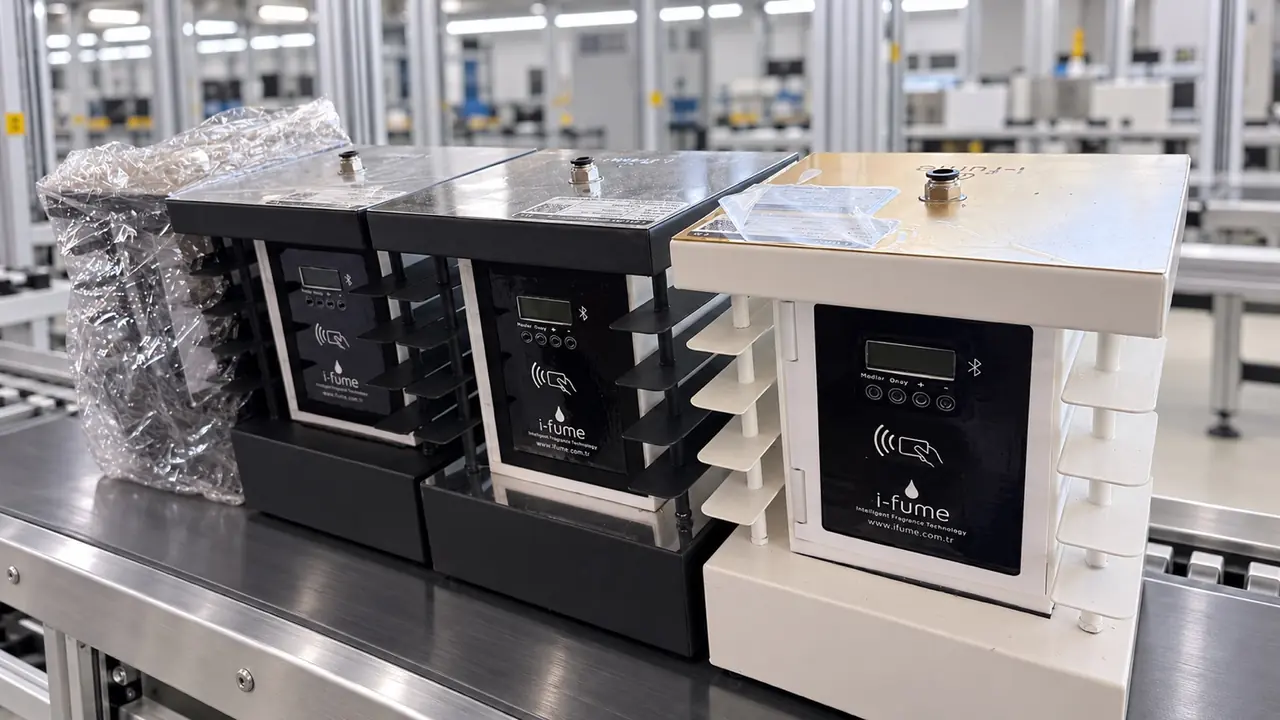
iFume final-assembly photograph · source: the corporate manufacturing page.
For an international buyer, working with a scent-machine manufacturer should connect three conversations: what the product is, where it is suitable, and how the installation will be supported. A specification sheet begins that process, but it does not resolve the layout, operating programme or responsibilities of a commercial project. This article explains the iFume approach through those procurement questions.
The manufacturer context in Türkiye
iFume is a manufacturer in Türkiye, with production, operations and logistics based in Silivri, Istanbul. The head-office and contact function is in Bakırköy. These locations describe the business context; they should not be confused with a claim about the origin of every component or a universal service arrangement in every export market.
The English manufacturing overview is the starting point for the company’s manufacturer identity. A project discussion then needs to move from that corporate information to the buyer’s actual environment: a hospitality arrival space, a showroom, a retail tenancy or a group of independent rooms.
Translate product features into project questions
iFume Akıllı Santral Pro has a 250 ml reservoir, uses a 12 V DC supply and supports nearby control through Bluetooth Low Energy. HVAC integration can be assessed for suitable projects. These features frame a technical discussion; they are not substitutes for a marked plan, operating hours and an agreed distribution strategy.
The declared coverage of up to 1,200 m³ does not establish the final quantity for every building. Reservoir volume does not set a fixed refill interval. Nearby BLE control should not be presented as an internet-based remote-control promise. Procurement teams benefit when these distinctions are settled before a quotation becomes an operating expectation.
| Product information | Question for the buyer and technical team |
|---|---|
| Declared coverage up to 1,200 m³ | Is this one connected air zone, and how will distribution be assessed? |
| 250 ml reservoir | What programme and usage log will support refill planning? |
| Nearby BLE control | Who will have access to settings at the installation? |
| Optional HVAC assessment | Which air path, zones and operating modes need review? |
| Declared 42 dB sound level | How will the proposed position be assessed in the actual acoustic setting? |
A sound-level declaration alone does not predict perceived noise at a reception desk or meeting position. Distance, placement and background sound matter to the site assessment. Similarly, an available integration option does not prove suitability for a particular air system. Keep the product statement and the application decision as separate lines in the brief.
A geometry example for commercial buyers
Suppose a buyer compares an open 360 m² showroom with three enclosed 120 m² spaces, all with 3 m ceilings. Both arrangements total 1,080 m³. If the enclosed spaces do not share fragrance reliably, however, they require separate zone decisions. The same overall volume is not evidence of an equivalent installation.
Using 600 m³ per diffuser only as an illustrative initial assumption would suggest two candidate units for the open arrangement and one per independent enclosed zone, giving three for the second arrangement. These are neither tested performance results nor a quotation. They show why a manufacturer’s product can lead to different project schedules when the boundaries change.
For a hospitality version of this exercise, the hotel diffuser-quantity guide works through a lobby and a separate lounge. A procurement file should record the assumptions behind its quantities rather than retaining only the final number.
Define support as clearly as the supplied equipment
Before ordering, agree who handles installation, programme changes, fragrance replenishment, routine attendance and fault reporting. Purchased equipment and a rental arrangement should not be assumed to include identical responsibilities. The accepted quotation or agreement needs to state what is included and which activities require separate coordination.
Operating issues may also originate outside the product. A changed ventilation schedule, new partitions or longer entrance-door opening periods can alter the experience. A short site log helps distinguish an equipment question from a change in the environment. That makes technical communication more useful than an unqualified request to increase output.
Build an export-project responsibility matrix
A distributor should identify the supplied model, intended applications, local technical contact, installation responsibility and the route for ongoing support. Delivery, local application and customer service may involve different parties. The scope agreed for one country or project does not automatically define the scope for another.
Documentation requirements, commercial terms and support arrangements should be requested for the actual destination and application. Product-origin percentages, certifications, patents or manufacturing procedures should be assessed through the relevant documentation, rather than inferred from general marketing language. This article makes no additional claim about those matters.
Prepare the first conversation
A useful enquiry contains the use case, drawings, zone volumes, known ventilation information, daily operating hours and the support model the buyer expects. Where information is missing, list it as an item to be resolved. Clear unknowns are more useful than assumptions embedded silently in the equipment schedule.
The English partnership section introduces the international collaboration route. You can share a project or distributor brief with iFume to discuss the practical fit. The aim is a manufacturer relationship built around a defined application and an agreed operating framework.
Last updated: