Conceptual fragrance-consumption tracking · not a measured test result.
A reservoir size is an inventory figure, not a consumption rate. To estimate fragrance demand for a commercial diffuser, separate the operating programme from the amount of liquid used while diffusion is active. The resulting estimate can support a stock discussion, but a refill commitment needs representative operating records rather than an assumed coefficient alone.
Calculate active time first
For a repeating cycle with diffusion time W and pause time P, the theoretical active fraction is W ÷ (W + P). Use the same units for both inputs. A 10-second diffusion period followed by a 90-second pause gives 10 ÷ 100 = 0.10, or a 10% active fraction. This percentage describes time; it is not a claim about commercial or scenting performance.
Over a 10-hour daily operating window, that programme produces 1 theoretical active hour per day. If it runs on 26 days in the planning month, the total is 26 active hours. No liquid volume has been calculated yet. Treating all 10 scheduled hours as continuous diffusion would bypass the pause cycle and misrepresent the programme.
Introduce an output coefficient with a stated basis
If the relevant consumption coefficient is q ml per active hour, theoretical daily demand is active hours per day × q. This article does not provide a measured iFume coefficient. The figures of 5 and 10 ml per active hour below are invented inputs used only to demonstrate sensitivity to that assumption.
| Input or result | Scenario A | Scenario B |
|---|---|---|
| Daily operating window | 10 hours | 10 hours |
| Theoretical active time | 1 hour/day | 1 hour/day |
| Assumed q | 5 ml/active hour | 10 ml/active hour |
| Theoretical daily demand | 5 ml | 10 ml |
| Theoretical demand over 26 operating days | 130 ml | 260 ml |
These are not measured product consumption figures, guaranteed refill periods or monthly cost commitments. Doubling the assumed coefficient doubles the estimate with no change in scheduled hours. A precise-looking result is therefore only as useful as the basis of the coefficient entered into the model.
Model separate time blocks separately
Suppose a site uses 10 seconds on and 90 seconds paused for the first 8 hours, followed by 5 seconds on and 95 seconds paused for 2 hours. The active times are 8 × 0.10 = 0.8 hours and 2 × 0.05 = 0.1 hours. Their total is 0.9 active hours per day.
At the purely hypothetical coefficient of 5 ml per active hour, the estimate would be 4.5 ml per day or 117 ml over 26 operating days. If weekend hours differ, calculate those periods separately. A user-interface intensity percentage should not be assumed to be a directly proportional liquid-volume setting unless the relationship is documented for the relevant device and programme.
Put the 250 ml reservoir in context
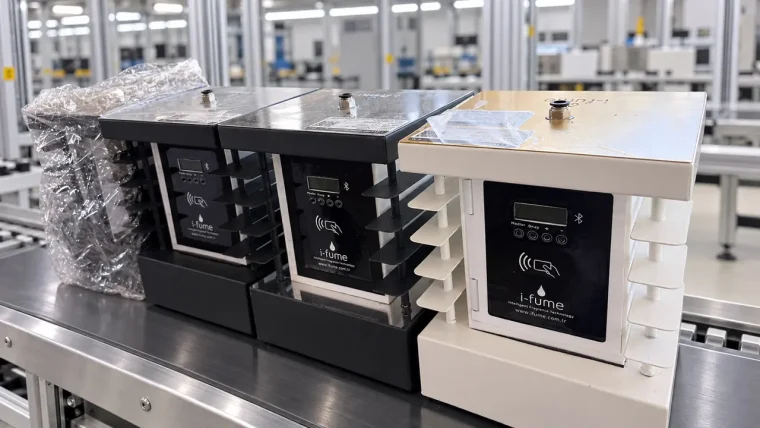
iFume Akıllı Santral Pro has a 250 ml reservoir. That capacity does not identify the actual starting fill, usable remainder or daily consumption. It should not be converted directly into a fixed number of days. The English technology overview explains the product context and nearby BLE control.
Once representative daily usage is established, dividing an appropriate remaining usable volume by that usage can provide a monitoring estimate. A service plan still needs to consider operating days, programme changes and the margin agreed for checking stock. The full nominal reservoir volume should not silently become a promise about usable inventory in every installation.
Replace assumptions with an operating record
Use an appropriate service method to record the starting amount, later remainder and any additions between observations. For that period, starting volume plus added volume minus remaining volume gives the liquid used. Keep the programme and actual operating days alongside the quantity record so the result can be interpreted.
If the method uses weighing, grams should not automatically be treated as millilitres; converting mass to volume requires the relevant liquid density. A short observation or a one-off programme should not be extrapolated to every month. Reassess the basis after a fragrance change, maintenance or a material programme adjustment.
Keep a device-level refill log
A practical log records device and zone, fragrance, dates, starting and remaining amounts, additions, programme, operating days and the person making the observation. Record uncertainty in the method rather than hiding it behind extra decimal places. With several units, calculate each device first and then aggregate the demand.
This helps distinguish a changing consumption pattern from a simple stock-count issue. For example, a later check after extended opening hours should not be compared uncritically with a shorter normal week. The same discipline helps a distributor or facilities team explain why a previous refill expectation needs review.
Use an estimator as a scenario tool
The English fragrance consumption estimator can compare operating-cycle scenarios. Treat example inputs as assumptions and update the discussion with observed usage. Equipment quantity and the definition of independent scent zones are separate decisions; the hotel planning guide illustrates that distinction.
For a project review, share the programme and a representative refill log with iFume. A useful estimate makes clear which quantities were measured, which were assumed and which still need confirmation. That is a stronger basis for procurement and service planning than a fixed duration inferred from reservoir capacity.
Last updated: