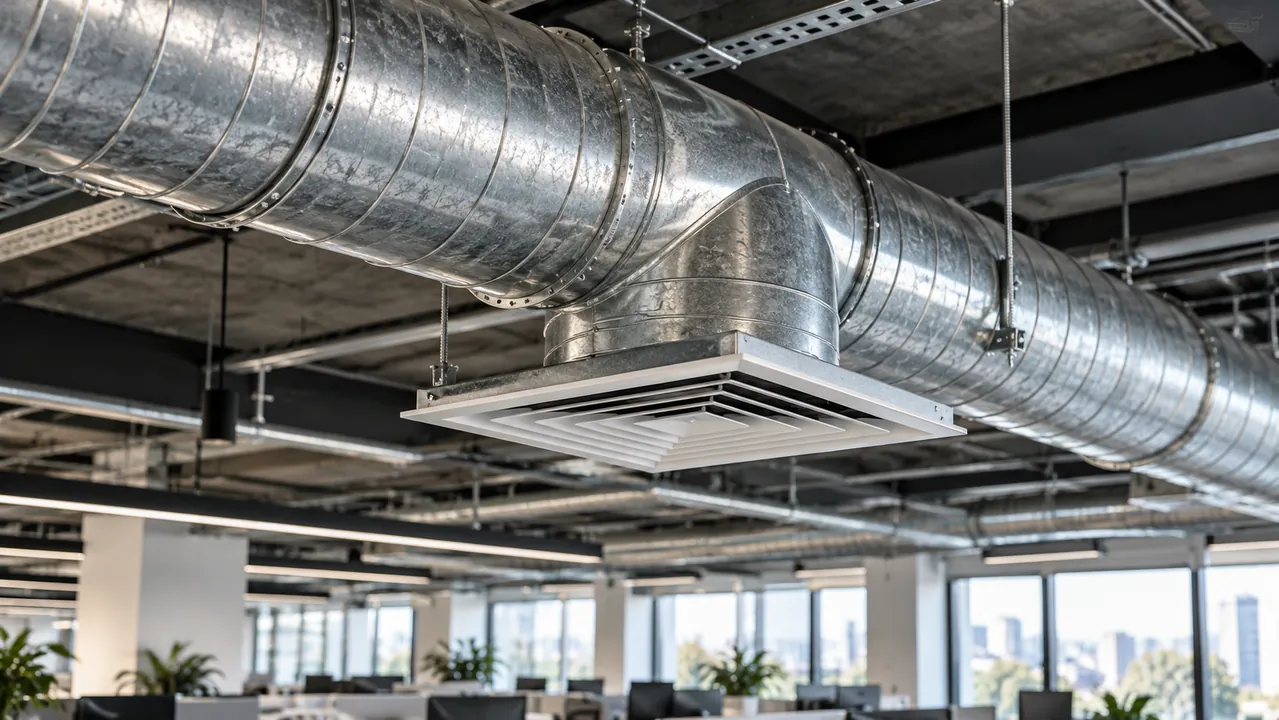
Conceptual HVAC duct and diffuser · not an actual iFume installation.
Ducted scenting is a distribution strategy, not a shortcut around a building-services review. A suitable scenting device can be connected to an appropriate air path so the system’s airflow carries fragrance towards the intended areas. Whether that arrangement is feasible depends on the actual air-handling layout, operating modes, device requirements and access for service.
Start with the air-system boundary
The outline of a tenancy or hotel floor is not necessarily the outline of an air zone. Adjacent rooms may be supplied by different air-handling units, while some spaces on separate floors may share a distribution path. Identify supply routes, returns, outside-air arrangements and the spaces each system serves before proposing a connection.
The presence of air conditioning alone is insufficient evidence. A room with a standalone split unit should not be assumed to have a suitable common duct network. Equally, a central plant does not establish that one scenting programme is appropriate for every connected area. Tenant requirements, operating hours and fragrance choices may differ.
Standalone and HVAC-connected approaches
A standalone device is positioned in the occupied environment and uses the available local circulation. Its relationship to seating, doors, physical obstructions and assessment points is central to the brief. A ducted arrangement adds a defined air-distribution system to that decision, along with controls coordination and service access.
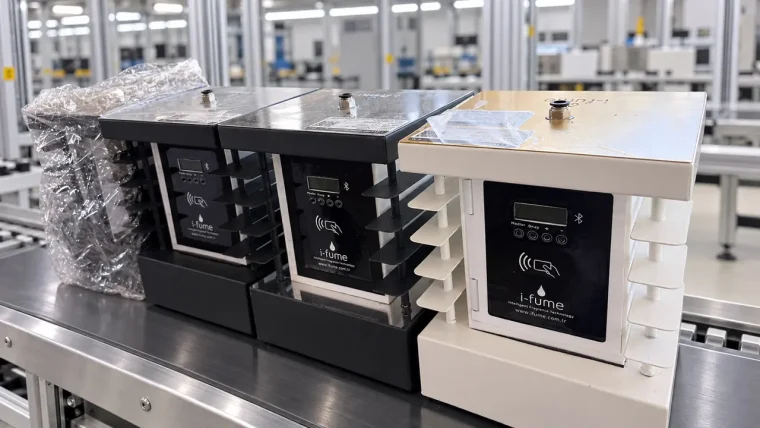
HVAC integration can be assessed for suitable iFume Akıllı Santral Pro projects. It is optional, and suitability should not be inferred from the product name or a generic building description. Different zones may justify different approaches within the same property. The English iFume technology overview provides the broader product context.
| Area | Known arrangement | Project question |
|---|---|---|
| Arrival lobby | Served by AHU A | What is the verified service boundary and operating window? |
| Retail floor | Independent AHU B | Does it require a separate fragrance programme? |
| Meeting rooms | Different doors and occupancy periods | Which rooms actually share a distribution path? |
The matrix is a briefing example, not a record of an installed system or an equipment schedule. Its purpose is to make the missing information explicit. “The building has HVAC” is not a complete response to any of the three questions.
Keep volume and airflow in their proper units
Internal volume is expressed in m³; airflow is expressed in m³ per hour. If a hypothetical 600 m³ zone receives a total supply flow of 1,200 m³/h, their ratio is 2 per hour. This arithmetic does not identify the outside-air fraction, predict fragrance concentration, or establish an arrival time at every occupied position.
The product’s declared coverage of up to 1,200 m³ is not a duct airflow rating. Likewise, the 600 m³-per-unit starting assumption used in some iFume planning examples is not an HVAC design calculation. Neither should be substituted for the system information required to assess a real installation.
Agree connection details with the responsible technical team
Supply and return arrangements, filters, dampers, changes in operating mode and the device manufacturer’s requirements all belong in the suitability review. The connection point, fixing method and any required coordination should be decided for the particular project. There is no universal instruction to connect every scenting device to the same part of every duct system.
A useful division of responsibility identifies who confirms the air-system information, who agrees the scenting arrangement, who carries out the installation and who accepts the operating settings. For international projects, local installation and service responsibilities should be agreed explicitly rather than inferred from a supply quotation.
Coordinate schedules before adjusting output
The scenting programme needs to reflect the air system’s real operation: normal hours, night modes, weekend shutdowns and event periods. Do not assume fragrance will continue to distribute normally when the serving fan is off. Whether controls coordination or an interlock is necessary must be defined in the project; it should not be presented as a standard feature of every device.
Increasing output is not a remedy for an incorrect zone assignment. First verify which spaces the selected air path serves. Then review the operating window and assess a low starting programme. Keep a record of settings so subsequent changes can be interpreted rather than becoming an undocumented sequence of adjustments.
Design for access and acceptance checks
Reservoir access, service points, connection inspection and routine attendance should be practical during the building’s operating life. Agree who performs those tasks and when access is available. An unobtrusive installation location is of limited value if normal maintenance cannot be carried out efficiently.
During the trial, compare positions near outlets with remote positions and longer-dwell seating areas. Review typical fan modes and entrance traffic, not just an empty-space demonstration. Observations from the hotel zoning guide can help structure the occupied-area brief, but final locations and quantities remain project decisions.
Scenting does not replace ventilation, cleaning or correction of an underlying odour source. The US EPA’s indoor air quality factsheet treats source control and ventilation as distinct management strategies. For a technical discussion, share the air-zone schedule and marked plans with iFume, including any unknowns that need a site assessment.
Last updated: